


Welcome to the third week of Peach Parchment’s 2026 Summerween celebration.
For the last two weeks, I have been sharing 1 horror book and 1 horror movie I curated as a mini-double feature with a distinct summer-horror flavor and a small common theme. Today’s theme: CANNIBALS!
Read Summerween I: HERE
Read Summerween II: HERE
How are you celebrating this year?
SUMMERWEEN III
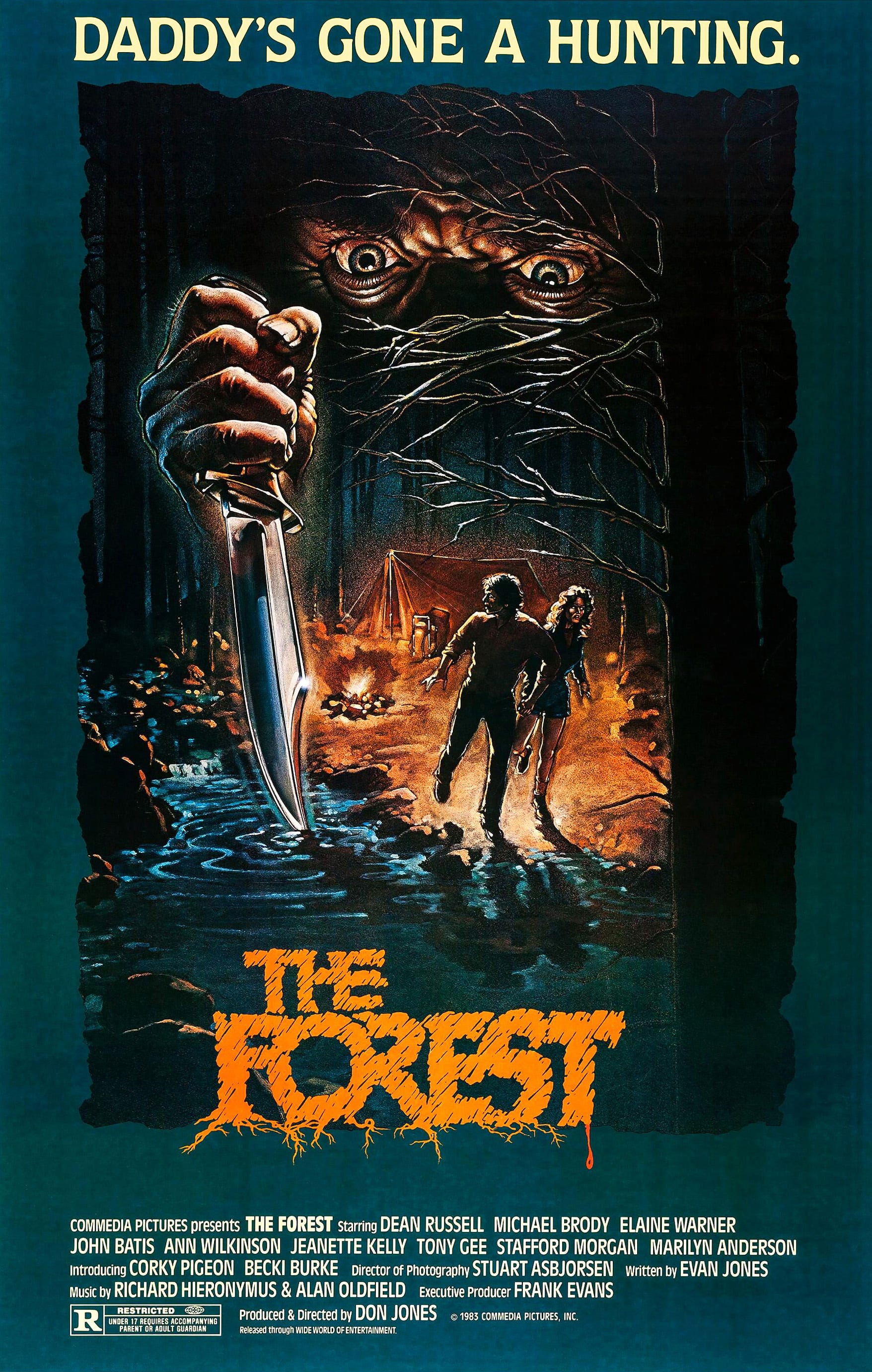
THE FOREST (1982)
The Forest begins with two friends stuck in a traffic jam. As they sit, they determine they’ve grown bored with suburban life in early ‘80s San Diego, California. Thus the duo aims to get back to nature to remind themselves they’re men.
At dinner, the men pitch this manly camping trip to their wives. However, the wives think the trip sounds fun and want to be included. Their husbands clarify this is going to be a rough trip not meant for lowly women.
Offended, but up for a challenge, the wives make a bet: The women will go into the woods one day early, to set up and camp alone. The following day, their husbands will join them… or, if need be… rescue them from the harsh wilderness.
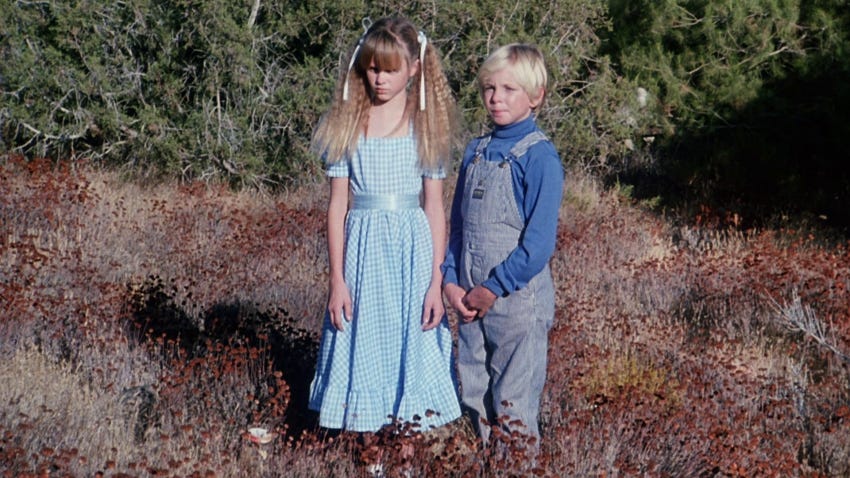
Once the women get into the woods and successfully build their camp, they meet two 10-year-old twins; a boy and a girl. The twins urge the women to avoid being found by their father. Spooked, but grateful, the women thank the twins, who promptly disappear.
The twins’ father, John, is a trip.
In a long flashback we learn that a couple years ago, John came home from work and discovered his wife in bed with another man. In a jealous rage, he strangled his wife, killing her, and then had a duel to the death (with farm equipment!) with the other man.
After John emerged victorious from the duel, he retreated to the woods with his children, feeling intense guilt over the murders. The trio took up refuge in a cave where John promptly cannibalized his children, having forgotten to pack any food. Thus we learn the twins we’ve met are ghosts!
Back in the present, John is eager to find these camping women so he can cook and eat them too. The Forest, filmed in 1981, was still early enough in the decade that it doesn’t have the hallmarks of ‘80s horror. Instead it feels more akin to a ‘70s TV movie; specifically in tone, atmosphere, and musical score. Unfortunately, this cannibal dad doesn’t supercharge the movie away from it’s lackadaisical tempo.
The Forest is full of plenty of walking in the woods footage. Plenty. Too much, in fact.
Once John emerges from his cave, there’s lots of moments of him walking in the woods. Before it cuts to the two women… walking in the woods. Where it then cuts to the husbands… walking in the woods. Before revisiting the ghost twins… walking in the woods. Once all these characters do converge a lot of good will has dried up and you’ll be begging for the movie to end.
The Forest isn’t goofy enough as a ‘so-bad-it’s-good’ style summer romp. So it might be worth skipping this one entirely. However there is one amusing little detail I got a kick out of: despite being a ghost, the twin girl has a different hairdo in each scene she appears in.
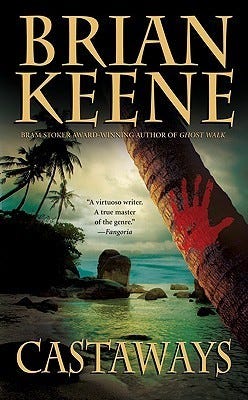
CASTAWAYS by Brian Keene
My first Brian Keene book. I found a mass market paperback copy inside of a Little Free Library in Vestal, New York. It seemed a perfect read for Summerween.
And yet, the promise of this book is much more appealing than it is in practice.
Originally written as a short story in 2001 before it was expanded into a novel in 2009. Castaways is essentially: What if a season of the reality show Survivor was overrun by a horde of cannibal monsters?
The book opens with a storm reaching the shores of a deserted tropical island. The weather makes it impossible to continue filming Castaways, but it does entice a species of half-human, half-ape monsters to emerge from a series of hidden caves and begin to eat the cast and crew.
Trigger Warning ahead: What seems like a fun pulpy romp is quickly soured by an odd inclusion into the story. These monsters don’t simply kill and cannibalize their victims, they also violently rape them. This isn’t done in a vague or subtle fashion, but is instead depicted in almost half a dozen different grotesque scenes. It more than thoroughly removes any sense of fun this ridiculous horror story might engender because Keene continues to return to this well over and over again.
While extreme horror is meant to explore all kinds of depths of depravity, here, it feels… uninspired. The characters all bleed into each other, the narrative never leaps beyond its central premise, and the rape is brutal, and seems to serve no more purpose than to make the story ‘shocking’. In the book’s afterword, Keene attempts to defend this story element by saying the original short story version was included in an anthology called In Laymon’s Terms; a volume of short stories inspired by the work of Richard Laymon.
Keene states he was inspired by Laymon’s Beast House. While Laymon is quite popular among genre novel enthusiasts, the Beast House books were quite early in his writing career and have been heavily criticized by heavy hitters Stephen King and Grady Hendrix.
Will Errickson, in his review of The Cellar, the first novel in the Beast House series states:
Laymon "writes" without wit or insight and seems to be making the plot up as he types. And so much of it is dull, dull, dull! Up to the last 20 pages, The Cellar is very often simply boring: my mind would drift off the page thanks to the inane, repetitive dialogue and the weak overall execution.
Errickson’s thoughts match many of my own thoughts on Castaways, so in that, perhaps Keene’s homage to Laymon’s early work was successful after all.
Well, you can’t win ‘em all.
Summerween III seems to have fit two duds.
But don’t worry! I think we’ll be back in the groove next week for Summerween IV.
See you then!
& as always,
Thanks for reading.
July 2026.